


Special Update of The Weekly Update 4/07/2025™
Pure Fear
There is a great deal of fear in the investor world today! The fear of a tariff war pushing the U.S. economy into a recession is the core cause.
You can see the fear level in the CNN Fear & Greed Index below. As of today April 7, 2025, it rests at an “Extreme Fear” level of 4 out of 100.
As you observe the chart below, note that one year ago it rested at the “Greed” level of 58.
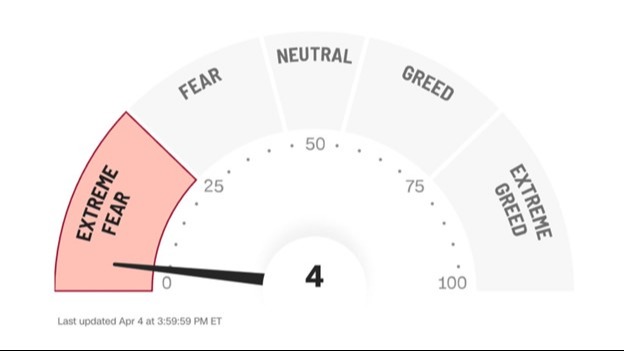
Source: cnn.com/markets/ Fear-and-Greed Index
Long time readers might remember the “Special Update” I wrote and emailed on 12-26-2018. In it I detailed my client Nate G.’s strategy to invest whenever the Volatility Index (the VIX) hit 30 or above. (Read it Here). When you click this link you will read that in Nate’s experience the market values were up one year later in 91% of the occurrences.
Per the chart below from this morning, April 7, 2025, the volatility Index rests at 54.56, i.e. way above Nate G’s requirement for 30 before investing.
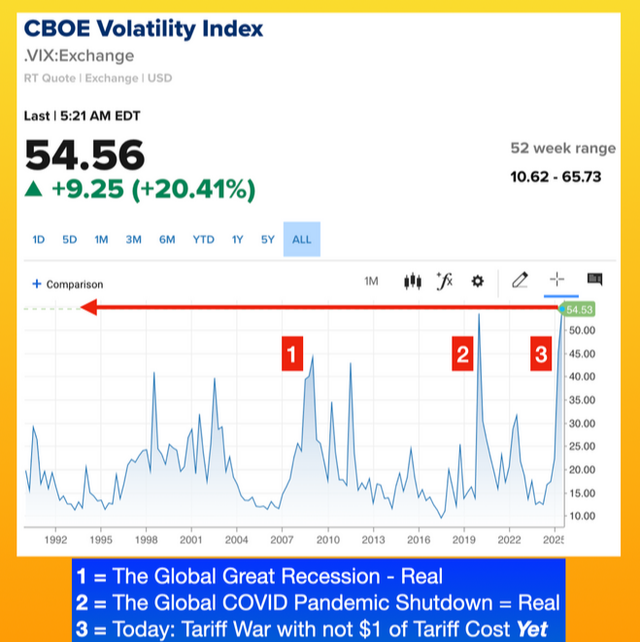
Source: CBOE Volatility Index .VIX:Echange
The VIX as of today is now at an all-time high record. This suggests investors today are now more afraid than they have ever been on any event in our history.
Which begs the question: “Does this seem reasonable, logical or normal”?
Of course not, and as of today, note point 3 above in the blue box, still not one dollar of tariff costs…. Yet.
The piece below is from FS Insights, and this suggests that if consumers take a tariff hit it could effect our economy by maybe $200 billion.
Our economy will soon cross $30 trillion making $200 billion a rounding error, I think!
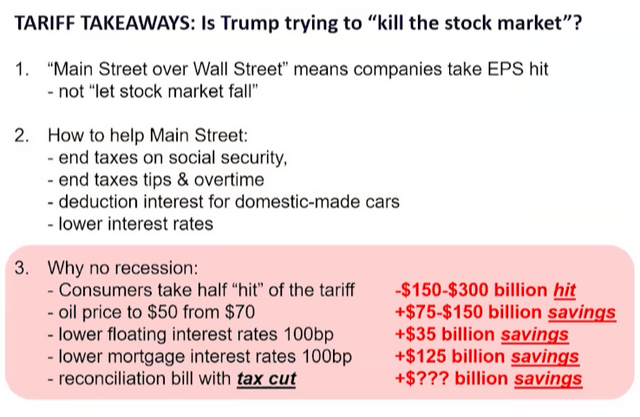
My take on this?
Per Goldman Sachs there is roughly $1 trillion in money borrowed against marketable securities at big institutional money managers and hedge funds.
Many are leveraged up (margin accounts) as much as 5:1. Much like a real estate investor who puts down 20% and borrows the other 80% from the bank. Same concept.
Now with the tariff projections suggesting Corporate America could see a reduction in their earnings per share, those loaning the money are calling it in. We call this a “margin call”.
If the market drops say 20% those hedge funds must sell to cover the loan and their 20% investment is gone, caput, out of business.
In my opinion, we are in the margin call selling window. It is unpleasant and far from fun, yet it will end.
Then historically this is what happens next.
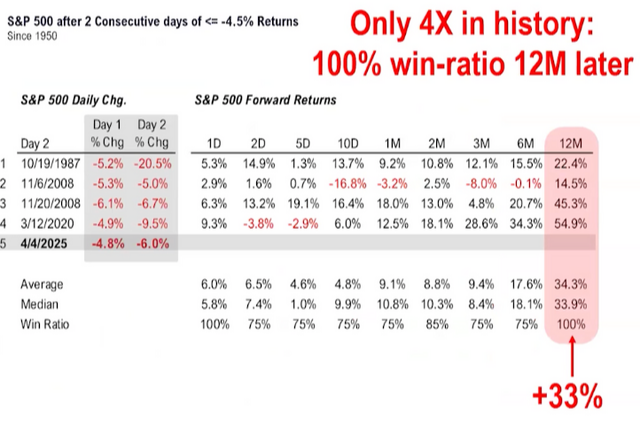
Source: Truvestments Research 4/7/2025
In the far-right red column, the average result has been +33%, 12 months later. Keep in mind these prior events actually happened; this one is still in the scare you to death stage.
Also, not seen or heard on the news for some reason, in the last 48 hours over 50 countries have been in touch with the White House to discuss the removal of tariffs from their side.
We will work our way through this round of volatility, yet in the meantime.
A quick review of my Rules of Clarity are in order.
The Rules of Clarity™
Markets have always gone up and down and the only way I know to eliminate the fear of volatility is to:
1) Know and accept that as a truth.
2) Have a thought process and strategy that will reduce the fear of volatility from your wealth building process.
3) Create your own confidence by taking a few measurements of valuation versus other points in time. For example, how current market valuations of Corporate America compare to prior periods in time based on what they earn. Consider using a Price/Earnings ratio, i.e., P/E ratio for this comparison.
The Clients of The Wealth Strategies Group understand our process for gaining clarity as: The Rules of Clarity™
1) Eliminate outstanding debt and have plenty of cash on hand to reduce worries during volatile economic times. This can include paying off your mortgage(s) for those inclined to think in terms of philosophy versus quantification.
2) Have a list of your monthly costs. Yes, a budget.
3) Know your sources of income, i.e. your earned income, retirement income, social security, etc.
4) You should consider allocating and diversifying your investments to reflect your constraints for time, risk and volatility. Once that is done, ALWAYS set aside a predetermined dollar amount to invest each month. At The WSG we refer to this as “Systematic Investing” or “Dollar Cost Averaging” * and it is how you grow assets in periods of economic volatility. If you don’t understand what this is, call and we’ll have a class!
I’m interested in your thoughts, comments and observations. Feel welcome to call, email, or stop by the office and say Hi.
Respectfully,
James O. Lunney, CFP®
CERTIFIED FINANCIAL PLANNER™ Professional
*Dollar cost averaging involves continuous investment in securities regardless of fluctuation in price levels of such securities. An investor should consider their ability to continue to purchase through fluctuating price levels. Such a plan does not ensure profit and does not protect against a loss in declining markets.
The opinions voiced in this material are for general information only and are not intended to provide specific advice or recommendations for any individual. To determine which investment(s) may be appropriate for you, consult your financial advisor prior to investing. Investing involves risk. Loss, including loss of principal, may occur. No strategy assures success or protects against loss. All performance referenced is historical and is no guarantee of future results. All indices are unmanaged and may not be invested into directly.
Copyright © 2025. The Wealth Strategies Group. All rights reserved.