


The Weekly Update 11/08/2024
Written by Brittany Jarocki CFP, (Jim's business partner, daughter and the succession plan Jim hopes he never needs).
As you can imagine, we have recently received a decent amount of questions around market performance during an election. Our answer is that generally we see volatility leading up to the election, as both parties say nasty things and use scare tactics to deter voting for the opposing party, but once the election is decided, things tend to settle.
The reason for this is that the financial market likes to know the variables it is working with. When the election is in process, the markets don’t know what the new policies will be, which creates uncertainty and volatility. Once the election is decided, the markets have a much clearer idea of the policies and what the impact will be going forward, and therefore they can move accordingly.
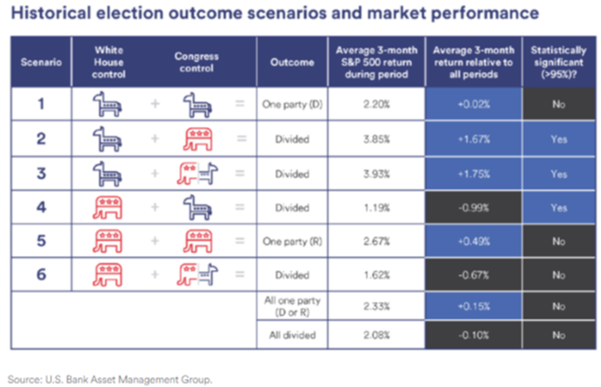
The image above compares the Average 3-month S&P500 return with the political party in place in the White House and Congress. Not surprisingly, the best returns in the S&P500 come when there is split control between government branches! Split parties between the White House and Congress have the most positive returns dating back to 1948.
Why?
Under a split scenario, it is very unlikely that any radical policies in either direction will get passed, so markets know that they can move forward in a rational way.
As you can see on the same chart, when one party gains total control is when we see less positive returns. This is due to 1) markets understanding that more one-sided policies will be passed and 2) people letting politics influence how they invest.
The key takeaways here are that, in general, there is little correlation and impact between market performance and political party in power. But even more than that is to know that we are not investing based on politics – we are investing based on the overall economic backdrop as measured by The Seven Signs of a Changing Economy facts each month!
I’m interested in your thoughts, comments and observations. Feel welcome to call, email, or stop by the office and say Hi.
Respectfully,
James O. Lunney, CFP®
CERTIFIED FINANCIAL PLANNER™ Professional
Securities and advisory services offered through LPL Financial, a registered investment advisor. Member FINRA/SIPC. The opinions voiced in this material are for general information only and are not intended to provide specific advice or recommendations for any individual Investing involves risks including possible loss of principal. No investment strategy or risk management technique can guarantee return or eliminate risk in all market environments.
All performance referenced is historical and is no guarantee of future results. All indices are unmanaged and may not be invested in directly. The economic forecasts set forth in this material may not develop as predicted and there can be no guarantee that strategies promoted will be successful. Stock investing includes risks, including fluctuating prices and loss of principal.
Asset allocation does not ensure a profit or protect against a loss. Value investments can perform differently from the market as a whole. They can remain undervalued by the market for long periods of time.