


The Weekly Update 6/20/2025™
Written by Brittany Jarocki CFP, (Jim's business partner, daughter and the succession plan Jim hopes he never needs).
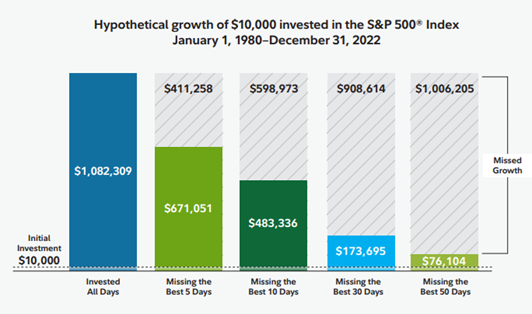
Source: Fisher Investments
Fun fact: Every bear market has been followed by a bull market. Not some, EVERY SINGLE ONE!
Bull markets are typically longer in duration (averaging 61 months) and stronger (averaging 180% returns) than bear markets (average duration of 13 months and -36% returns), reinforcing the importance of staying invested long-term despite bear market volatility, as markets historically recover and surpass previous highs. Source: Schwab research.
It is a common and understandable reaction to want to move to the sidelines during market volatility, but doing so will likely set you up for continued loss versus weathering the storm. As you can see from the chart above, missing the best 5 days from 1980 until 2022, investment returns are reduced by over $400,000. Investors are far better off to stay invested in even the most severe pullbacks than missing any part of a bull market.
The “best days in the market” can happen deep in bear market territory as well as on the way out. There is no way to know when these days will happen, so trying to time them is impossible.
Here at TWSG, we are long-term investors i.e. 5+ years in the market. There has never been a pullback that has lasted more than 5 years in the past four decades. Thus, it is reasonable to assume that 5 years from now, financial markets will be higher than they are today.
If the recent volatility has kept you up at night, it may be time to revisit The Rules of Clarity™:
1) Eliminate outstanding debt and have plenty of cash on hand to reduce worries during volatile economic times. This can include paying off your mortgage(s) for those inclined to think in terms of philosophy versus quantification.
2) Have a list of your monthly costs. Yes, a budget.
3) Know your sources of income, i.e. your earned income, retirement income, social security, etc.
4) Consider allocating and diversifying your investments to reflect your constraints for time, risk and volatility. Once that is done, ALWAYS set aside a predetermined dollar amount to invest each month. At The WSG we refer to this as “Systematic Investing” or “Dollar Cost Averaging” * and it is how you aim to grow assets in periods of economic volatility. If you don’t understand what this is, call and we’ll have a class!
I’m interested in your thoughts, comments and observations. Feel welcome to call, email, or stop by the office and say Hi.
Respectfully,
James O. Lunney, CFP®
CERTIFIED FINANCIAL PLANNER™ Professional
*The economic forecasts set forth in this material may not develop as predicted and there can be no guarantee that strategies promoted will be successful.
The opinions voiced in this material are for general information only and are not intended to provide specific advice or recommendations for any individual. To determine which investment(s) may be appropriate for you, consult your financial advisor prior to investing. Investing involves risk. Loss, including loss of principal, may occur. No strategy assures success or protects against loss. All performance referenced is historical and is no guarantee of future results. All indices are unmanaged and may not be invested into directly.
Copyright © 2025. The Wealth Strategies Group. All rights reserved.